
The People of IR-4 series introduces the incredible IR-4 team members who make our success possible and our community one-of-a-kind. Today, meet Leona Horst, a USDA Agricultural Research Service employee and Field Research Director for IR-4. Here, Horst shares her experiences as a farm kid who grew up to be a plant pathologist, and the rewarding path her career has taken.
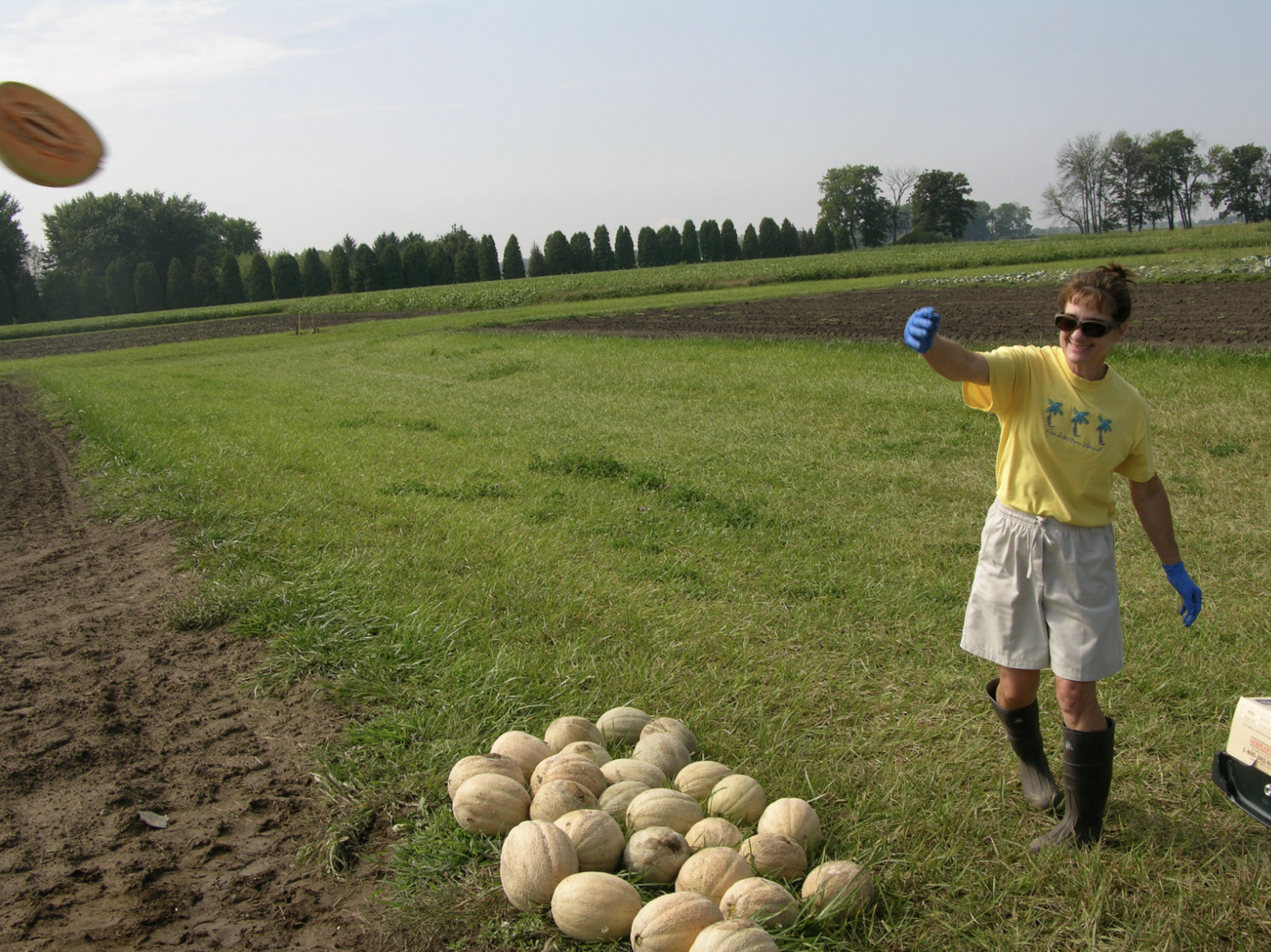
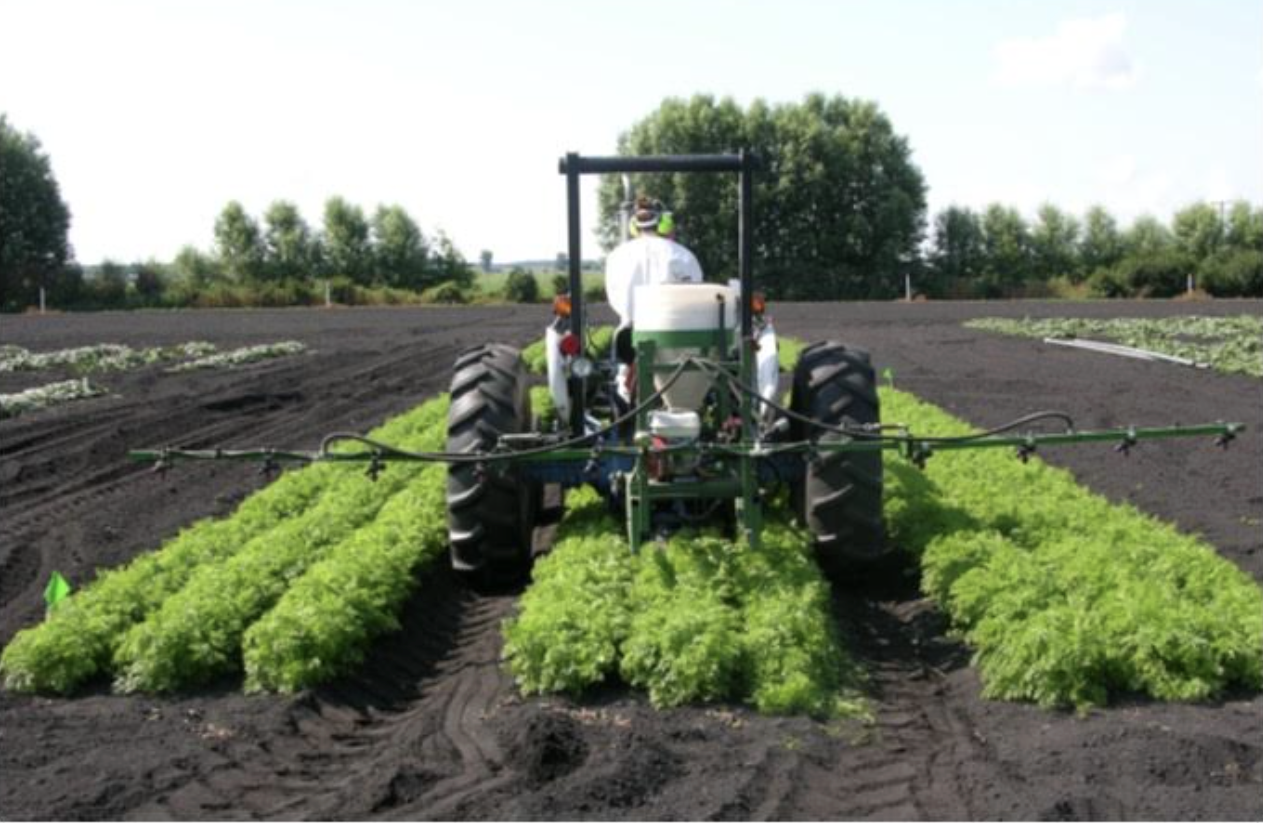
(Photo by Andrew Doklovic, USDA Agricultural Research Service).
Leona Horst grew up on a family farm in Ohio, working to care for hogs, cows, and around 400 laying hens. When she wasn’t working with animals, she was working in the fields, combining wheat or helping harvest the family’s two-acre fruit orchard and preparing the fruit for sale. These childhood experiences became the foundation for Leona’s lifelong journey with agriculture and serving local growers. As Leona prepares for retirement, she reflects on this rewarding career and the community of scientists she has worked with over the years to help bring better pest management tools to specialty crop growers.
In 1972, Leona began her undergraduate studies at the University of Akron in Ohio, on the pre-medical track in the biology department. She had a particular interest in medicine and diseases. After graduating in 1976, she realized that she was only a few classes short of certification to teach secondary science, so she pursued the certification through evening classes.
After teaching for a short time, Leona heard about a plant pathology job opening at the USDA’s Agricultural Research Service (ARS) that would allow her to pursue research in agriculture—sparking both her personal and academic interests. Once in the position, Leona’s supervisor encouraged her to pursue a master’s degree in plant pathology. Leona saw this as the perfect opportunity to dive deeper into her interests.
It kind of fit in with my initial work with medicine, because plants and diseases were something that I hadn’t even thought about when I was doing my undergraduate work. But it fit perfectly with what I was interested in. So that’s kind of how it evolved into plant pathology, because I always had an interest in diseases, and realized that there’s a whole field out there of plants and diseases.
During this time, both studying and conducting research with ARS, Leona dove into the work, finding keen interest and meaning in helping solve farmers’ challenges after growing up on a farm herself.
I’m a farm kid, and growing up on that farm, I knew what farmers faced: trying to come up with sellable produce. And so, combining that with plant pathology, it really intrigued me, and learning how we can help the growers control diseases and get a viable crop to sell really impacted my enthusiasm for pursuing the research that we were doing in pathology.
Transitioning into IR-4 and finding symmetry at square one
 |
 |
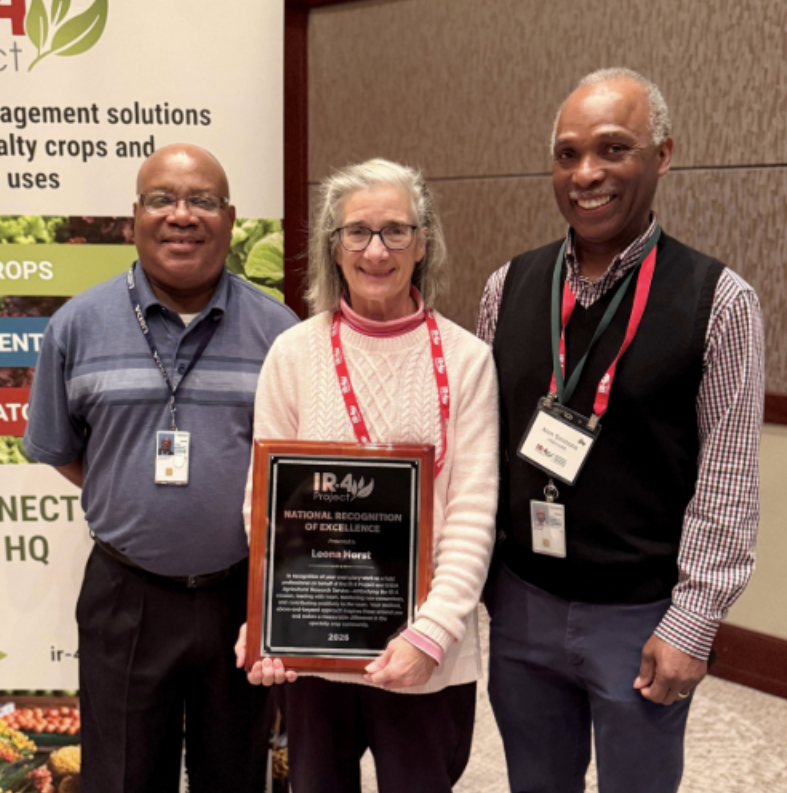
| The National Recognition of Excellence being presented to Horst by Joe Munyaneza and Alvin Simmons. |
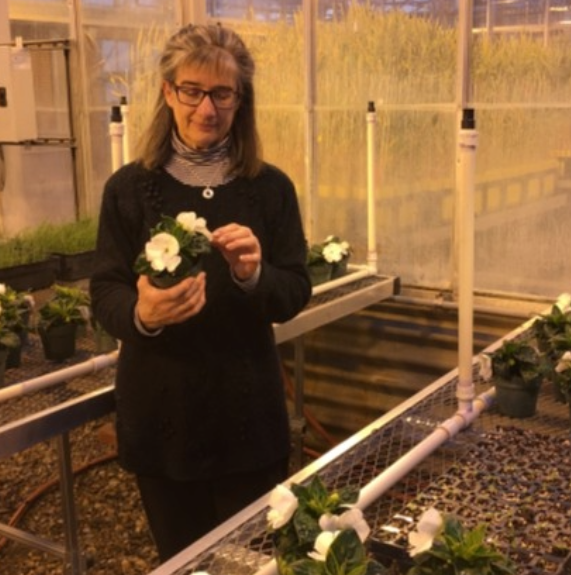
Horst with an Ornamental trial in the greenhouse (photo by Leslie Morris, USDA Agricultural Research Service). |
Leona got involved with the IR-4 Project early in her career, starting her role as a field research director (FRD) for ARS trials in 2005 at Ohio Agricultural Research and Development Center (OARDC) at The Ohio State University in Wooster, OH, after being involved from the beginning of her research station’s engagement with IR-4.
When I took my job in plant pathology, it was the same time that they were starting to establish IR-4 at Wooster. I was asked if I would be the backup person or the extra helper when needed for the person doing IR-4 studies. Well, that position evolved into what we now call the field research director. When that person resigned…I applied and became the field research director. So that’s how I kind of got started; I was just being a second person when they needed a second pair of hands.
Leona’s collaborative work with IR-4 became a focus of her career. She spent (roughly) April-September doing a majority of FRD work, and the winter months focused on plant pathology research done in greenhouses.
Throughout her career, Leona has tackled many key issues facing Ohio growers, including fungal pathogens like Diplocarpon rosae on peppers and tomatoes, as well as mildew on cucurbits. As part of the application research technology unit at ARS, a key focus of her research is increasing the efficacy of pesticide application. This work has included projects exploring how to make sprayers more effective and how to decrease the amount of pesticides people have to use to control diseases.
This work has also involved outreach to help local farmers with their pesticide applications, which Leona has found makes a measurable difference for growers.
For several years, we held sessions with growers, and we literally trained them how to calibrate their sprayers, so that they would have uniform output. So that was always rewarding to see them realize that, oh, if I have a clogged nozzle, it’s not going to be putting this spray out where I want it, or it won’t be uniform across the plant, and then I might have issues.
Leona’s team has used a variety of educational methods to help local farmers improve their control and application skills—for example, using UV dye and blacklights to show exactly where their active ingredients go.
Leona’s work with IR-4 has strengthened her connection with growers, empowering her to provide them with pest management tools to address their specific needs. During grower meetings, she sees the impact that additional pest management resources make on her community. Growers regularly check in with her to see what IR-4 is currently researching and whether their needs and challenges are on the priority list. In Leona’s mind, grower outreach and interaction are at the heart of her responsibility as a field research director. Leona’s connection to local growers and deep care for their success is clear in her dedication to her work and involvement in the agriculture community.
In the words of her colleague, Alvin Simmons, a research entomologist for ARS and regional field coordinator for IR-4, “working with Leona has been a highly productive and positive experience. She consistently provided timely and high-quality data, was innovative and adaptive, and demonstrated exceptional professionalism and dedication to our shared objectives.” In 2026, Simmons nominated Leona for IR-4’s prestigious National Recognition of Excellence award, which she received from IR-4’s national leadership at the National Education Conference.
No mistakes, just new lessons learned
Over the years, Leona has learned valuable lessons about what it takes to succeed as a field researcher, and she’s generous with her knowledge, coaching young researchers on how to adapt to the constant challenges of fieldwork. As successful as she has been in her role, Leona is quick to emphasize that conditions are always changing, and there’s a real learning curve in this work. Being able to innovate, improvise, and adapt is important. This is a key message she wants to pass along to young researchers coming up in the IR-4 network.
“As a farmer, that’s what you do: this is what I have, so how do I work with it? You have to work with the weather and the conditions you’re given and coordinate with a Study Director and persevere,” Horst emphasized.
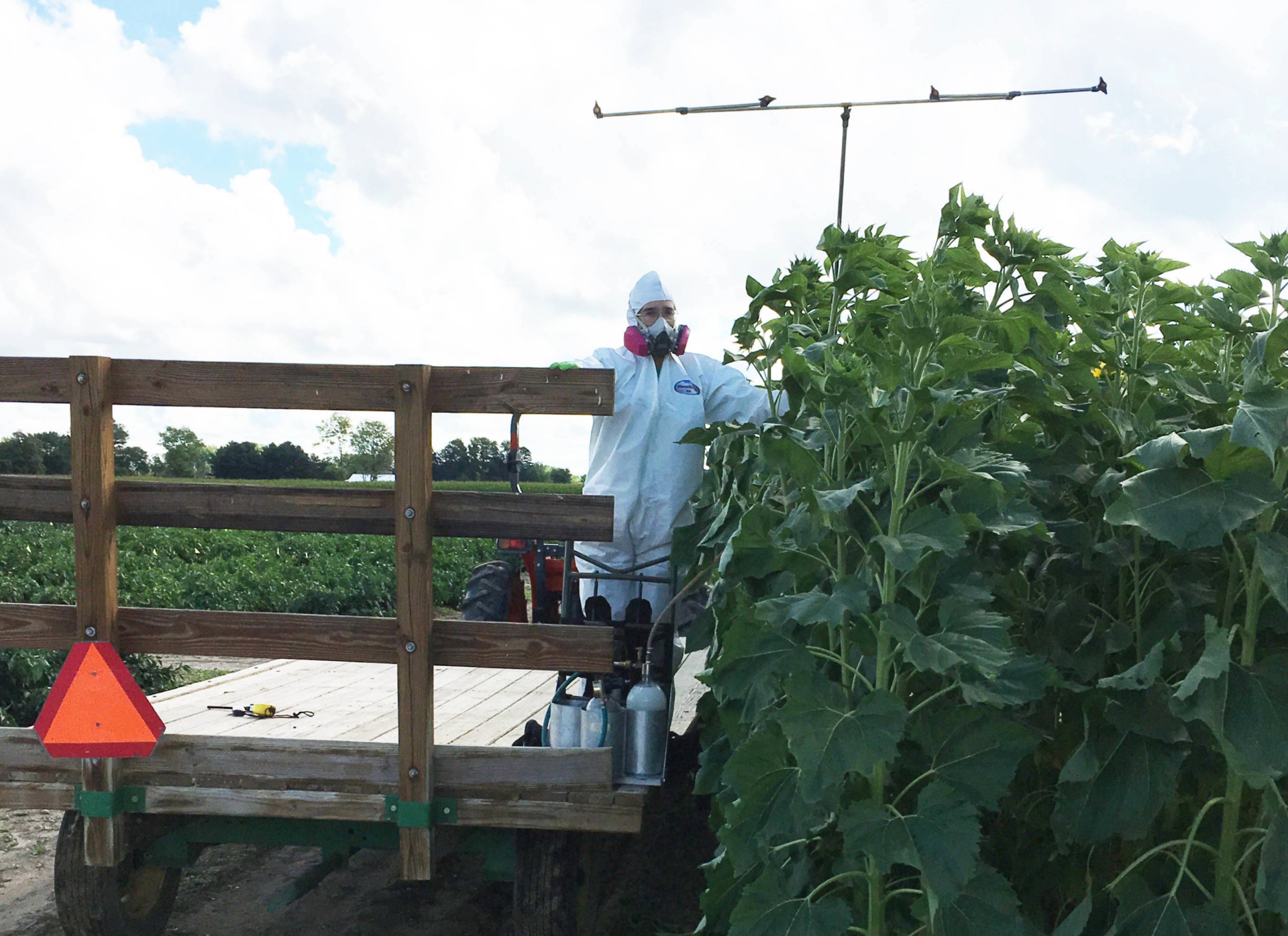
Whether it is muddy fields trying to steal her boots during applications, or crops of 19-foot-tall sunflowers when she only has 15-foot sprayers, Leona has learned, “Once you start the application, you just keep walking, and if you lose your boots in the field, you lose your boots in the field!”
Looking to the future
As Leona approaches retirement, she is excited to see younger people coming into her field, bringing fresh perspectives and tech savviness. Still, passing the torch presents challenges—the hands-on familiarity and knowledge of the multitude of specialty crops that IR-4 works on, and the particulars of GLP research, are pivotal to pass on to the next generation, and top of mind for Leona during this transition.
It’s a challenge to pass the knowledge you have of all the different crops you work with onto the person or persons who might replace you. And so I’ve already been thinking about what to pass on. Even just notes I’ve taken about, you know, if I plant the crop now, it’ll be in bloom now. It’ll be in harvest now. That type of information is invaluable for the next people coming on.
As a field research director, Leona has significantly impacted the careers and lives of many younger researchers, including Allison Robinson, a former IR-4 Field Research Director at The Ohio State University, who shared:
Leona is one of the reasons I pursued learning about GLP research. After seeing her extensive skills and so much attention to detail, I realized that it was something that I wanted to grow in doing and learning. She was always willing to help and listen to my infinite questions, often leading to long conversations, which helped me get to know her as both a researcher and friend. I am so grateful for her training and her friendship. And, if you haven’t tried it, she also happens to produce the best apple cider!
New kind of full-time
Outside of the field, Leona also works part-time, teaching a general biology class for non-biology majors. She has continued her work in the classroom for over 20 years. She enjoys getting to expose undergraduate students to new things and even shares information with them about the role of IR-4 and its impact on specialty crop agriculture. “I even have farming kids in my class, so they understand,” Leona shares.
Leona will continue teaching in her retirement. Along with teaching, her schedule is shaping up to be busier than ever with all her favorite activities. She looks forward to working on her family orchard, integrating biological controls into her production. When she is not in the orchard, Leona is excited to invest more time in personal passions like quilting, hiking, biking with her great-nieces and nephews, and volunteering.
A lifelong songbird, Leona also plans to continue her involvement with her choir. Participants in IR-4’s National Education Conference got a sample of some of Leona’s talents as she shared a lyrical adaptation of the song, “My Favorite Things,” called “My Least Favorite Things,” to bring some lighthearted fun into issues researchers often face in the field:
LEAKS IN THE HOSES AND SAND IN THE NOZZLES
RACCOONS IN THE SWEET CORN AND DEER IN THE GREEN BEANS
HIGH WINDS AT NOON AND THE MUD IN MY BOOTS
THESE ARE A FEW OF MY LEAST FAVORITE THINGS
The positive energy, adaptability, and mentor mentality that Leona has brought to the IR-4 community, as well as the compassion and dedication she has to serving growers, are unparalleled. The IR-4 team commends Leona on her integrity and dedication, both to her mission-driven fieldwork and to her mentorship of the next generation. Thank you, Leona!
About The IR-4 Project
The mission of the IR-4 Project is to facilitate regulatory approval of sustainable pest management technologies for specialty crops and specialty uses to promote public well-being. By working directly with local crop growers across the country, IR-4 conducts research and develops data necessary for the registration of pest management tools, ensuring that they are safe for use. To learn more, visit our website.